Tuesday, August 25, 2015

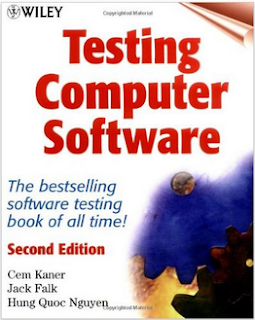
Testing Computer Software - A must-have for QA Personnel

(click the image)
 Who this book is for: Testers and Test Managers Project Managers-Understand the timeline, depth of investigation, and quality of communication to hold testers accountable for.

Sunday, August 23, 2015

Conventional Testing Is Dead ... Long Live Testing

My response to the following article


Point-1: QUALITY is at the root of our profession, in all things, in all ways

If we are to define traditional testing as point-and-click behind a desk, or using a mobile device, then the old ways were in serious need of evolution. The fundamentals for testing reside in the extraordinary lengths by which we go to to find defects. But, the entirety of quality assurance is just that ... assure the quality of the product. That includes the processes, plans, and methods that are employed, and the people who execute these plans.

Successful automation program relies on disciplined practices. A tester can be good at coding, but has added value when the fundamentals of QA are at the heart of the test cases.

Testers need to be good programmers as well moving forward ... they should be able to learn and evolve latest automation frameworks and work with scripting technologies to stay relevant.

I concur with this sentiment as it reflects my current situation and the glaring deficiency in my skill set. I acquired many skills in management but that pales in comparison with the need to know coding and at least one testing framework.

Point-2: Automation is a means to an end, not an end unto itself. This new trend is forgetting that.

Automation is not a panacea. It will not find low-hanging-fruit. It cannot suggest new test methods. It is a matter of perception as to the worth of a QA tester, but what automation WILL do is reduce the time taken to execute menial tasks freeing up time to concentrate on more important matters.

I remember testing an app looking for a memory leak. A simple loop with a count marker iterated through the process of taking a photo repeatedly until the app crashed. A second execution of this script a few seconds less before crashing.

The point: by hand, finding this memory leak would have been tedious and undoubtedly taken hours. Employing automation in conjunction with continual manual testing, I was able to report my findings with supporting evidence.

Point-3: Sloppy is as sloppy does! Automation will not credit development hours to the timeline if the developer remains undisciplined and careless in their work.

This was my battle as a QA Engineer. In my research, I came across many many frameworks that were too limiting, too expensive, or not completely what we needed. Appium so far has proven to be the leading tool (one that has gotten a lot better to use since its first few versions last year, I might add). As I write this, I have made the commitment to fill the knowledge gap and learn this tool along with learning JAVA. What started out as a WANT is now a MUST HAVE. I recommend this to everyone not already onboard with automation or programming.

Test engineers need to be product experts, quality advisers and analyzers of risk.

Conclusion:The ultimate end of QA is far beyond bug-finding, way more indispensable than opening and closing tickets, and too valuable to be relegated to writing test plans and test cases.

It is imperative to be versed in all things relevant to Quality Assurance, but the age of automation is upon us. Manual testing, month-long full regression test cycles, and iterative testing are all a thing of the past. Like the old Model-T giving rise to a sleek 2015 Ford Fusion, QA Analysts give rise to Software Engineers in Test and are becoming full fledged members of DevOps.

Like it or not, this is only the beginning!!
Thursday, January 1, 2015

What Food Service Taught Me about QA


What I learned in 2014
I confess to you, my audience, that it has been a long long time since my last blog post. Something I do not intend to repeat this year.
As 2014 has come and gone and a new year is now upon us, a lot ... I mean a lot of lessons were learned from the many projects I was assigned to test. But of the truths that have become self-evident, one constant remained certain - my past has taught me well.

I wasn't always in Quality Assurance. Matter of fact, I wasn't in the IT field until my early 30s. When I graduated college, I had aspirations to become a writer or publishing agent.

Then the internet happened, and I found myself steadily growing in my current position as a waiter. I made it to bartender, pastry chef, eventually a personnel manager responsible for a staff of 65 waiters, 12 supervisors, and 9 bartenders.

At some point, I turned 30 and realized this wasn't the life for me.

As I transitioned to IT from my former life, the following lessons have served me well:

  • Garbage In, Garbage Out
    How a meal is presented is determined by so many factors: mood of the chef, the time to cook the meal, etc. The quality of the ingredients will determine the product.

    The same goes for a project. A rushed assignment, with minimal information and a lack of product knowledge, coupled with an unmotivated tester who's been undermined will lead to a very sub-standard product.
  • Work Clean
    A clean workstation is vital to the success of a product, be it a 4-course meal, or a multi-faceted website with a robust backend. Cleanliness means, the developer's coding habits are sound.

    His / Her work environment is well-maintained. The product requirements are approved and not lacking.

  • Be Versatile
    When I was young, I had a pretty full schedule as a waiter, but eventually the work got lighter. Then I learned how to bartend, then eventually to supervise others. Since then, my schedule got fatter.

    The point is that versatility is key to a successful career as a QA Analyst / Engineer / Manager. One has to think like an end-user; have as much product knowledge as a business developer; approach the project like a project manager; and test wit the creativity of an artist.

    Never limit yourself to one skill set. Always keep learning something new and challenge yourself.

  • Everyone Matters
    One day I happened to be in the kitchen when I saw the owner of the restaurant willingly roll up his sleeves and help the dishwashers out. I never had more respect for someone as I did that day. That was how I knew what good management looked like.

    I learned no one person is more important than any other on a project.

    While the perception may be that QA is at the bottom of the totem pole, never forget that it takes a strong base is the foundation for everything. And quality is the foundation that holds everything up!

  • Have The Right Tools
    Good cooking requires quality of ingredients, precise measurement, and the right tools. Not a lot a chef can do with a dull knife.

    The same goes for testing. The right tools includes having the right state of mind (motivation), having the right mise en plase (PRD, Test Plan, Test Cases, etc.), and a solid understanding of what the scope of testing entails.

    It behooves a tester to have proper product knowledge so as to fully test and provide support to the developers.

 Conclusion: I took a lot of dinner orders, served a lot of drinks, and pleased a lot of people with my service.

I learned people will always come back for good food, good service, and a great atmosphere. So it is with business that repeat Clients will stay based on great service and a quality product. And its our job as QA people to be a part of that effort.

!! Happy New Year !!